Discover Choquequirao Trek 5 Days: The Full Citadel Experience
Northeast of Cusco, where the Apurimac River cuts a canyon beneath the Vilcabamba mountain range, sits one of Peru’s most remote Inca sites — reachable only on foot. The snow-capped Salkantay, rising to 6,271 meters (20,575 ft), watches over the route from a distance, but the real draw here is what’s hidden deeper in the canyon: Choquequirao, a citadel most visitors to Peru never see.
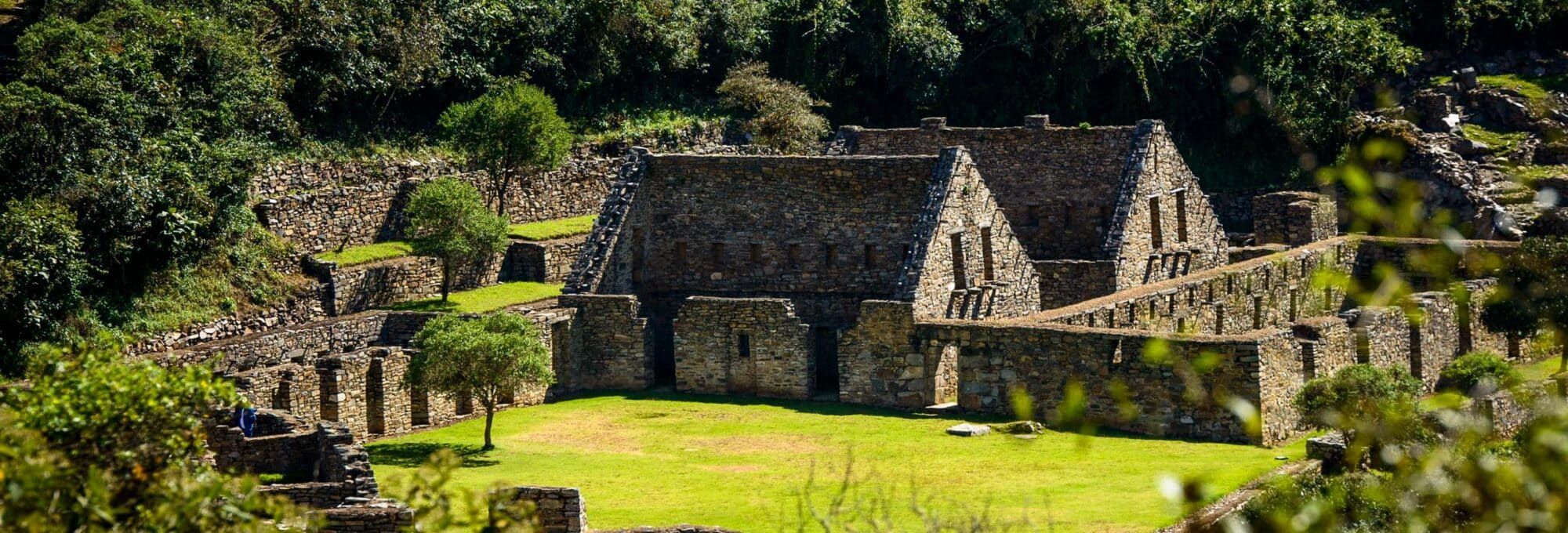
This 5-day itinerary is built for travelers who want more than a quick look. Rather than fitting the citadel into a single rushed afternoon, an entire day is set aside just for exploring it — the lower terraces, the Ushnu ceremonial platform, and the white-stone llama iconography carved into the walls.
The canyon itself is home to species rarely seen elsewhere in the region, including the Andean condor, puma, and spectacled bear. Long before it became a trekking destination, this same rugged terrain sheltered the last Inca resistance fighters in the 16th century — and local oral tradition still holds that somewhere nearby lies a hidden “El Dorado,” a legend archaeology has yet to confirm or deny.
Duration
5 days
Tour type
Trekking
Difficulty
Challenging
Guide
Inglés, español
Group size
6 to 10
Maximum altitude
3700 masl
Itinerary
Day: 01 Cusco – Capuliyoc – Chiquisca
The trek sets off from Cusco between 4:00 and 4:30 am, driving to the Andean community of Cachora (2,800 masl). From there, a short 25-minute walk brings us to Capuliyoc, where our muleteers and pack mules join the group before the real climbing begins — a steady 2.5-hour ascent to the Capuliyoc pass, overlooking the Apurimac River.
The pass rewards the effort with sweeping views over the Apurimac Canyon and the mountains beyond. From here, it’s a 2-hour descent to Chiquisca, with a good chance of spotting birds, foxes, viscachas, or even a puma along the way. Chiquisca serves as the first night’s camp for the entire trek.
Walking time: ~4 hours
Climate: Warm, with mosquitoes present
Camp: Chiquisca
Day: 02 Chiquisca – Playa Rosalina – Choquequirao
After a hearty breakfast in Chiquisca, we’re on the trail by 6:00 am, heading toward Playa Rosalina — just a 30-minute walk away. From there, we cross the Apurimac River and face the trek’s steepest test: a 2-hour climb to Santa Rosa. Starting early isn’t optional here — it’s what keeps this stretch from becoming brutal once the canyon heat sets in.
A 30-minute break in Santa Rosa precedes the next push — another 2.5-hour climb to Marampata (2,850 masl), where lunch comes with a first proper look at Choquequirao itself, perched at roughly 3,103 masl and long nicknamed the “sister” of Machu Picchu. From Marampata, camp is just 20 minutes from the archaeological site.
Walking time: ~7 hours
Climate: Warm by day, cold at night
Camp: Near the Choquequirao Archaeological Site
Day: 03 Full Day at Choquequirao
Breakfast starts early, around 6:00 am, ahead of a full day exploring the citadel. The morning is spent in the lower section, walking among agricultural terraces cut into steep, dramatic terrain, past water channels and cliffside paths. We visit the so-called “priest’s house,” a nearby waterfall, and stop often for photos along the way.
After lunch, the visit shifts to the upper sector — the most architecturally striking part of Choquequirao, home to the storage buildings (colcas) and the Ushnu, a ceremonial platform once used for religious offerings. We also see the famous white-stone llama terraces, built with astronomical alignment in mind, before settling in to watch the sunset fall over the Apurimac River from above.
Activity: Full-day guided visit, moderate walking within the archaeological complex
The morning brings one more guided walk through Choquequirao before we start heading back — a chance to take in details easy to miss on the first pass. Built in the 15th century along the Apurimac Canyon, the citadel served both administrative and religious purposes, and today only around a third of it has been excavated and restored, with archaeologists expecting it will eventually rival Machu Picchu in scale and recognition.
Highlights on this final look include the site’s advanced water channels, the Great Complex, the Main Plaza, and the elite and religious quarters surrounding the agricultural terraces. From there, the return route retraces our steps through Marampata and back down through the canyon to camp at Chiquisca (1,930 masl).
Walking time: ~6 hours
Climate: Warm
Camp: Chiquisca
Day: 05 Chiquisca – Capuliyoc – Cusco
After breakfast, we leave camp for the final climb — roughly 2 to 3 hours back up to the Capuliyoc pass, where lunch awaits with one last view over the canyon we’ve spent the past few days exploring. From there, it’s a 2-hour walk down to Cachora as the afternoon winds down, where private transport is waiting to take the group back to Cusco.
Walking time: ~4–5 hours
Climate: Warm, cooling in the afternoon
End point: Cusco
How to Get to Choquequirao (5-Day Trek)
Of the four Choquequirao itineraries we run, the 5-day trek is the one built around patience — an extra day at altitude, an extra buffer against bad weather, and none of the rush that shorter routes require. It still starts the same way: a pre-dawn private transfer from Cusco along the Cusco–Abancay highway, turning off at Ramal onto a 16 km dirt road that drops into San Pedro de Cachora.
Climate Along the Route
Cachora sits at 2,903 masl, dry and clear from April through October, wetter from November to March. The town itself offers a first glimpse of what’s ahead — including Padreyoc, the snow-capped peak visible on the horizon.
From here, the trail becomes a study in contrasts. Andean farmland gives way to a scorching, cactus-lined canyon floor, which in turn climbs into cool cloud forest beneath the Vilcabamba range — three distinct ecosystems inside a single day’s walk.
Into the Canyon
Past Chiquisca, the trail drops sharply to Playa Rosalina, at the bottom of the Apurimac Canyon, roughly 19 km from Cachora. A suspension bridge carries hikers across the river, marking the start of the long climb toward Choquequirao — a climb the 5-day itinerary spreads out rather than compresses.
The route passes through Santa Rosa, worth a stop for a taste of “cambrai,” a local sugar-cane drink, before continuing on to Marampata. From there, camp near Choquequirao is roughly 90 minutes away — close enough that the extra day here is spent exploring the citadel itself, not rushing toward it.
Choquequirao Trek 5 Days — Day-by-Day Summary
Day 1: Cusco → Capuliyoc → Chiquisca
Day 2: Chiquisca → Playa Rosalina → Choquequirao
Day 3: Full day exploring Choquequirao
Day 4: Choquequirao → Marampata → Playa Rosalina → Chiquisca
Day 5: Chiquisca → Capuliyoc → Cusco
Trip Details
Activities: Hiking, trekking, and adventure travel through the Apurimac Canyon.
Difficulty level: 4 out of 5 (challenging) — the extra days make the pace more manageable than the shorter routes, but the terrain itself doesn’t get any easier.
Maximum altitude: 3,050 masl / 10,006 ft (Choquequirao Archaeological Site).
Minimum altitude: 1,550 masl / 5,085 ft (Apurimac River crossing near Playa Rosalina).
Lodging: Camping for 4 nights, with a full support team handling setup.
Type of tourism: Trekking, hiking, nature, and Inca archaeology.
Group size: 6 to 10 people, with a professional bilingual guide (English and Spanish).
Meals included: Breakfast, lunch, and dinner throughout the trek — see full details in Inclusions.
Departure days: Daily departures available; minimum of 2 people required per group.
Best season: April to November (dry season) is recommended for optimal trail conditions.
Minimum age: Recommended for travelers aged 12 and older due to the physical demands of the route.
Start: Hotel pick-up in Cusco around 4:00 am.
End: Drop-off at your hotel in Cusco around 6:00 pm on Day 5.
Highlights
Spend a full day exploring Choquequirao — the only itinerary among our Choquequirao treks with an entire day dedicated solely to the citadel, from the lower agricultural terraces to the Ushnu ceremonial platform.
Descend into the Apurimac Canyon, crossing the Apurimac River by suspension bridge en route to one of Peru’s most remote Inca sites.
Explore Choquequirao, the 15th-century citadel long considered the “sister” of Machu Picchu — with only about a third of it excavated and restored to date.
Camp within 20 minutes of the archaeological site itself, close enough to catch the citadel at sunrise and sunset without the crowds of a day-trip destination.
Wildlife sightings are common along the trail, including Andean foxes, viscachas, and — for the fortunate few — pumas.
Best hiked from April to November (dry season); the rest of the year, landslides can occasionally close sections of the trail.
A more gradual pace than the 3 or 4-day routes, with shorter daily distances that make the physical demands of the trek more manageable without lowering the difficulty of the terrain itself.
Included
What’s Included
Pre-departure briefing ahead of your Choquequirao trek.
Morning hotel pick-up in Cusco and transfer to Cachora, the trailhead.
Entrance ticket to Choquequirao, covering both travelers and our support team.
Camping tents.
Professional bilingual guide (English/Spanish).
Cook and full kitchen equipment.
Muleteers and pack horses, carrying camping gear, food, and kitchen supplies.
Meals: 4 breakfasts, 5 lunches, 4 dinners.
First aid kit.
Private transportation from Cusco to Cachora.
No Included
Not Included
Breakfast on Day 1.
Dinner on the last day.
Sleeping bag: $ 25 USD per person
Air mattress: $ 25 per person
Walking poles: $ 20 USD per pair
Personal tent: $ 30 USD (booking in Cusco)
Food not mentioned as breakfast on the first day and lunch on the last day.
What to Bring for the Choquequirao Trek (5 Days)
Original passport (required for trail registration).
A warm jacket, hat, and gloves — nights at camp drop well below the daytime canyon heat.
Waterproof jacket or rain poncho.
Comfortable, quick-dry T-shirts — pack an extra one given the additional day on the trail.
Comfortable hiking pants.
A wide-brim sun hat.
Broken-in hiking boots — this is not the trek to test out new footwear.
An extra pair of socks — five days on your feet makes a dry backup pair worth the space.
A reusable water bottle or hydration bladder.
A headlamp with spare batteries (more practical than a handheld flashlight).
Camera, plus a spare battery or power bank — there’s no outlet to recharge anything until you’re back in Cusco.
Sleeping bag — not included in the tour price, but available to rent with us.
Health & Personal Care
Sunscreen, SPF 35 or higher recommended — reapply often on the full day exploring Choquequirao, when you’re exposed for hours with little shade.
Insect repellent.
Personal toiletries.
Any personal medication you take regularly.
Water purification tablets or extra cash for bottled water along the way, as a backup — boiled drinking water is provided daily as part of the tour.
Optional
Trekking poles with rubber tips.
Basic blister care: tape, bandages, moleskin.
Sandals for camp, to give your feet a break in the evenings.
Energy bars or trail snacks for the full day at the citadel — lunch is included, but a little extra fuel helps during hours of walking between sectors.
Extra cash for snacks, drinks, or souvenirs along the way.
Choquequirao Trek 5 Days 4 Nights — Pricing 2026
Choose between joining a small group departure or booking a private tour with a dedicated guide. This trek requires a minimum of 4 travelers to guarantee departure.
Service Type
Group Size
Price per Person
Group Tour
Shared group (6–10 people)
$499.00 USD
Private Tour
2 people
$ 769.00 USD
Private Tour
3 people
$ 680.00 USD
Private Tour
4 people
$ 620.00 USD
Private Tour
5 people
$ 590.00 USD
Private Tour
6 people
$ 549.00 USD
How to Reserve Your Spot
Minimum group size: 4 travelers, to guarantee this itinerary departs as scheduled.
Reservation deposit: $200 USD per person, paid online to confirm your booking.
Remaining balance: due in cash (USD or Peruvian Soles) or by card in Cusco, at least one day before departure.
Card and PayPal payments carry a 5% processing fee, charged by the payment gateway, not by Aremika Expeditions.
Once your deposit is received, you’ll get a confirmation email with your booking details and a pre-departure checklist.
Price Guarantee
Your price is locked in the moment your deposit is confirmed — it won’t change due to currency shifts, seasonal demand, or later price updates on this page.
Cancellation & Rescheduling
Reservation deposits are non-refundable, but in most cases can be applied toward a rescheduled date if you notify us at least 15 days before departure. Contact us directly for specific circumstances.
Private tours include a dedicated bilingual guide and flexible departure times. All prices include the services listed in the “What’s Included” section above.
Why Choose Aremika Expeditions for the Choquequirao Trek 5 Days 4 Nights?
Trusted by over 999 travelers on TripAdvisor.
Full Day at the Citadel: An entire day dedicated to exploring Choquequirao, unhurried.
Camp Steps Away: Just 20 minutes from the site — sunrise and sunset without the crowds.
Is the extra day really worth it compared to the 4-day trek?
If seeing Choquequirao properly matters more to you than saving a day, yes. The 4-day version fits the citadel visit into part of one day; here, you get an entire day with nothing else on the agenda — lower terraces in the morning, the upper sector and Ushnu after lunch, sunset over the Apurimac to close it out. It’s less about covering more ground and more about not feeling rushed once you’re finally there.
Is the entrance ticket to Choquequirao included?
Yes — the entrance ticket is included for both travelers and our support team, so there’s nothing extra to arrange or pay for once you arrive at the site.
Do we camp in the same spot for two nights?
Yes, on Days 2 and 3. Since the trek is built around Choquequirao, we set up camp about 20 minutes from the citadel and stay there for the full-day visit, rather than packing up and moving every single day like some longer treks require.
How does this compare to the Inca Trail or Salkantay in terms of altitude?
Lower and gentler on your lungs. Choquequirao tops out around 3,050 masl, while the Inca Trail’s Dead Woman’s Pass sits above 4,200 masl and Salkantay’s pass climbs past 4,600 masl. The trade-off is that Choquequirao makes up for lower altitude with steep, repeated descents and ascents in and out of the canyon — different kind of hard, not necessarily easier.
Is this trek suitable for families with teenagers?
It can be, for teens who are already reasonably active. We generally recommend this route for travelers 12 and older given the daily walking hours and terrain, and the slower pace of the 5-day version makes it more forgiving for a mixed-fitness family group than the 3-day option would be.
What’s the rainy season like on this route, and should I avoid it?
Rain isn’t just uncomfortable here — from December through March, sections of the trail can be affected by landslides, and visibility on the canyon descents drops considerably. It’s not automatically canceled, but April through November remains the more reliable window if your dates are flexible.
Who sets up and takes down camp each day?
Our support team — cooks and muleteers travel with the group and handle the entire camp setup, meals, and breakdown. Hikers carry a daypack for the day’s essentials; everything else moves by horse.
Can this trek be combined with a visit to Machu Picchu afterward?
Not directly within this 5-day itinerary, since it starts and ends in Cusco. For travelers who want both Choquequirao and Machu Picchu in one continuous route, our 7-day Choquequirao to Machu Picchu trek is built specifically for that.
How many hours do we actually walk on the shortest day?
Day 3, the full day at Choquequirao, involves much less pure walking than the trail days — most of the time goes into exploring the site itself rather than covering distance, which makes it a welcome break for your legs partway through the trek.
Is this a good first multi-day trek for someone with no prior experience?
It’s a reasonable choice, more so than the 3-day version. The slower daily pace gives your body more time to adjust, and having a full rest-and-explore day at Choquequirao breaks up the physical demands better than a compressed itinerary would for someone doing their first multi-day hike.



 Duration
 Tour type
 Difficulty
 Guide
Guide Group size
 Maximum altitude